
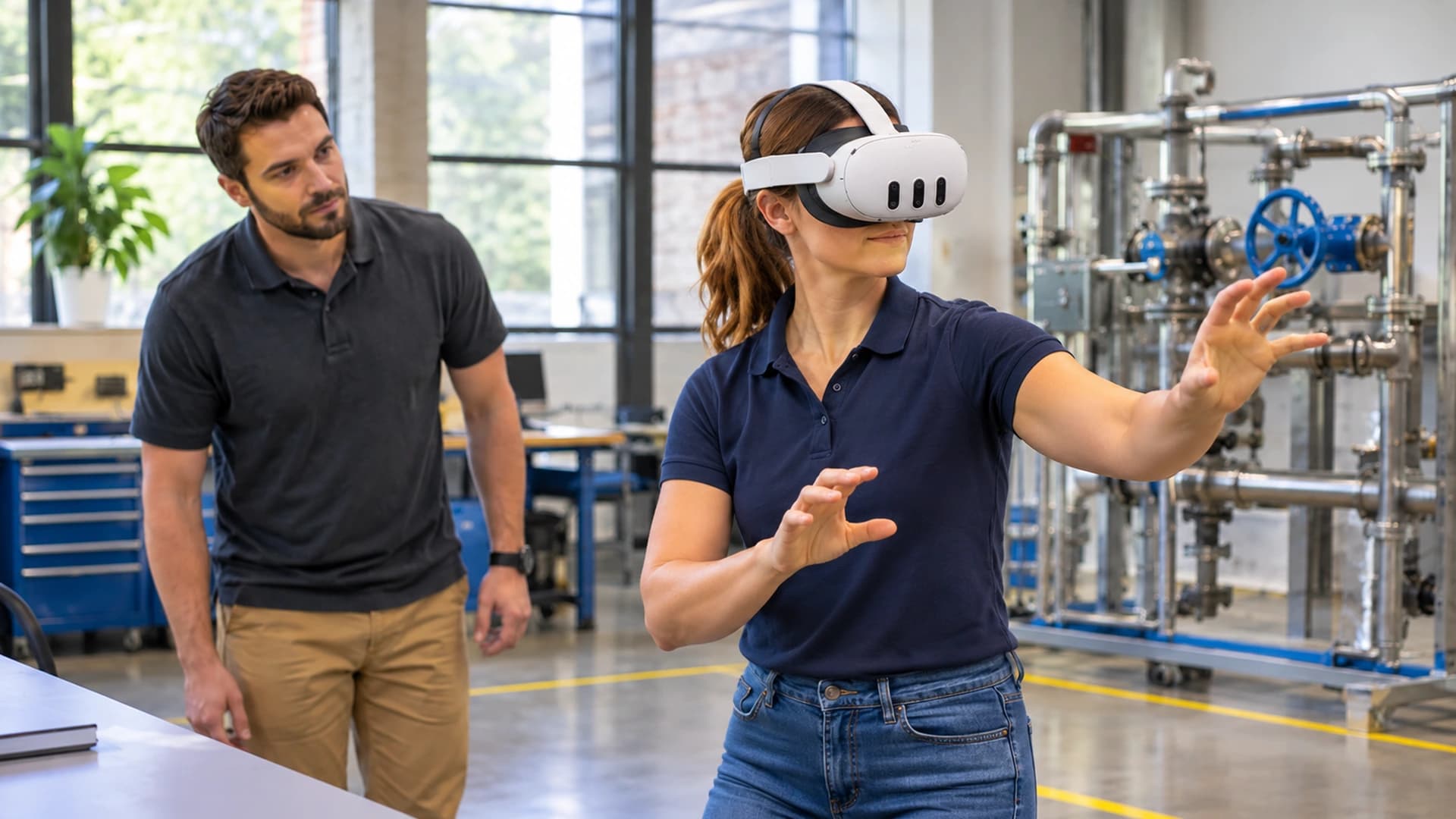
Why Custom VR Software Projects Struggle Beyond the Prototype
A virtual reality demonstration can make a complex idea tangible, from a trainee practising a difficult decision to an engineer inspecting a simulated environment. Yet an impressive demonstration is not the same as reliable software an organisation can use repeatedly.
For businesses considering custom VR software development, difficult questions emerge after the initial concept: Will it work consistently on the intended headsets? Can people use it comfortably? Who installs updates? How will the organisation measure value?
For South African businesses, education providers and event teams, these questions shape the scope, cost and lifespan of an immersive project. The strongest business case is for software that fits a real operating environment.
A prototype proves possibility, not routine use
A VR prototype reveals whether a simulated task feels credible, users understand the interactions and a concept warrants investment. But prototype conditions are favourable: a controlled room, a prepared headset and a specialist nearby.
Regular use introduces different demands. An employee may have little time to learn unfamiliar controls. A trainer may need to reset a scenario between participants. An event organiser may need a dependable session flow for several hours. A business application also needs clear recovery paths when someone exits early, loses tracking or selects the wrong option.
A prototype asks, “Can this experience work?” A deployable application asks, “Can it keep working when ordinary people use it under ordinary conditions?”
Headset compatibility is a moving target
VR software depends on headsets, operating systems, controllers and tracking capabilities. Targeting one device may simplify the first release but complicate future fleet replacements.
The industry has made progress on portability. The Khronos Group's OpenXR 1.1 announcement in April 2024 explained how the standard incorporates widely used extensions to reduce fragmentation across immersive platforms. That helps developers work with more consistent interfaces, but it does not make every headset identical. Input layouts, device performance and platform-specific functionality still need practical consideration.
Universal compatibility is not always necessary, and promising it without testing is misleading. What matters is knowing which devices and features the project depends on.
Performance must survive a full session
Smooth VR interaction requires responsive rendering, simulation and controls within finite hardware resources. A scene that performs well in a brief demonstration may behave differently during repeated sessions.
This is a current platform concern, not a hypothetical one. In technical guidance updated in September 2026, Meta explains that sustained workloads can trigger thermal management, reducing performance or causing a device to enter a cool-down state. Its advice is to consider the full session rather than judging performance only at startup.
Visual ambition must match the device and session length. Stable performance and dependable recovery can matter more than maximum graphical detail.
Deployment is part of the software, not an afterthought
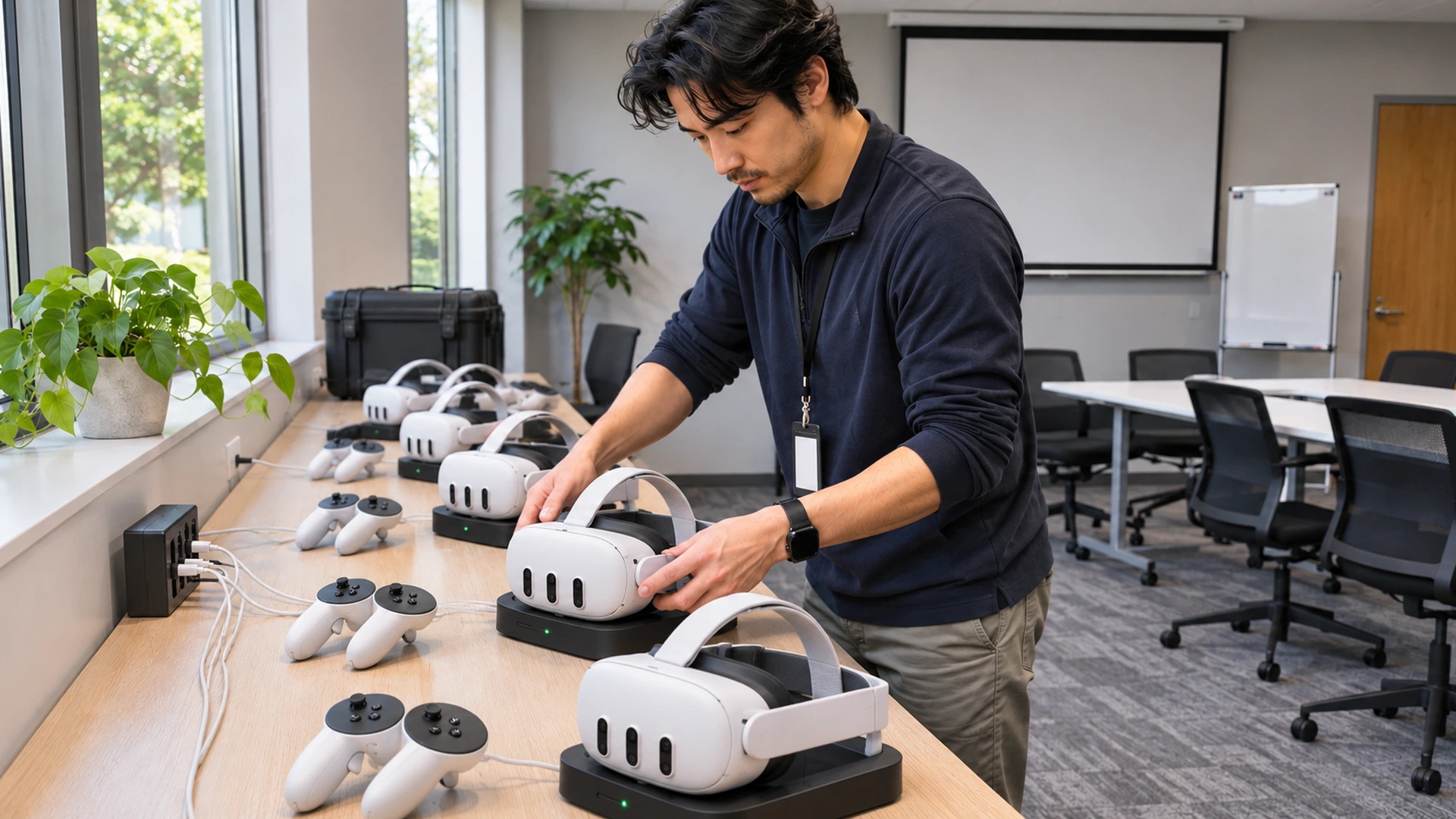
A headset in a development office is easy to supervise. Headsets across training rooms create an operational system requiring installation, version control, storage, updates and support.
These choices now have dedicated enterprise tooling. Meta's October 2026 guidance on managed app distribution describes private deployment routes and administrative policies for application installation, storage and updates. Delivery does not end when the application has been built.
Connectivity also deserves attention. Some environments can support online services and synchronised content, while others need a more self-contained experience. Neither approach is universally better. The correct design depends on whether the experience relies on live data, remote supervision, authentication or a stable network connection.
The user experience is a workplace requirement
People vary in VR familiarity, physical mobility and tolerance for immersive movement. An experienced user may find an interaction natural that a first-time participant finds uncomfortable.
The ISO 9241-820:2024 standard addresses ergonomic and human-system considerations in immersive environments. It is a reminder that interface design involves the person as well as the hardware: readable information, appropriate movement, clear instructions, physical space and a sensible way to stop or resume an experience.
Some participants may need an alternative to a headset, making the service more inclusive and realistic.
Data practices become more important at scale
A VR experience does not automatically need to collect personal information. But a training system might record completion, scores or individual progress. Other applications may introduce account records, analytics or device-related information. Once personal information is involved, questions about access, retention, security and purpose become part of the software conversation.
South African organisations must consider the Protection of Personal Information Act (POPIA) where it applies. The Information Regulator's guidance on information officers emphasises organisational compliance frameworks and personal information impact assessments. Information collected through VR deserves the same governance as other business software.
Keeping data collection proportionate to the business purpose can simplify both the user experience and ongoing administration. Specific legal obligations should be assessed for the actual implementation rather than assumed from the technology alone.
A useful outcome is more persuasive than novelty
The most important unresolved question is often not technical: what will count as success? A learning application may be expected to improve comprehension or decision-making. A product demonstration may need to make complex features easier to understand. A professional workflow may aim to reduce friction in reviewing a design. Those outcomes are different and require different evidence.
Research on immersive training is promising but not a blank cheque. A 2025 systematic review in Computers in Human Behavior Reports identified positive findings across digital industrial training studies while noting limitations such as small samples and inconsistent evaluation methods. It would be unsound to turn general research findings into a guaranteed return for a particular organisation.
Project value is better judged against its purpose than generic claims about engagement. Business relevance comes from observable outcomes.
The real investment is in an enduring application
The challenges of enterprise VR development are interconnected. A change in hardware affects performance testing. A change in user group affects comfort and onboarding. An additional training location affects distribution and support. A new reporting requirement affects the data model and privacy considerations.
Together, these issues explain why a convincing prototype can be only a small part of production. Business decisions must account for devices, operational ownership, maintenance and evidence of value.
AltVR's VR Software Development service covers consultation and strategy, custom development, implementation and support for tailored immersive applications. For organisations considering a business-specific VR experience, the discussion can begin with the real-world task the software needs to serve and the conditions in which it will operate.
To explore a project with those practical requirements in mind, contact AltVR.