
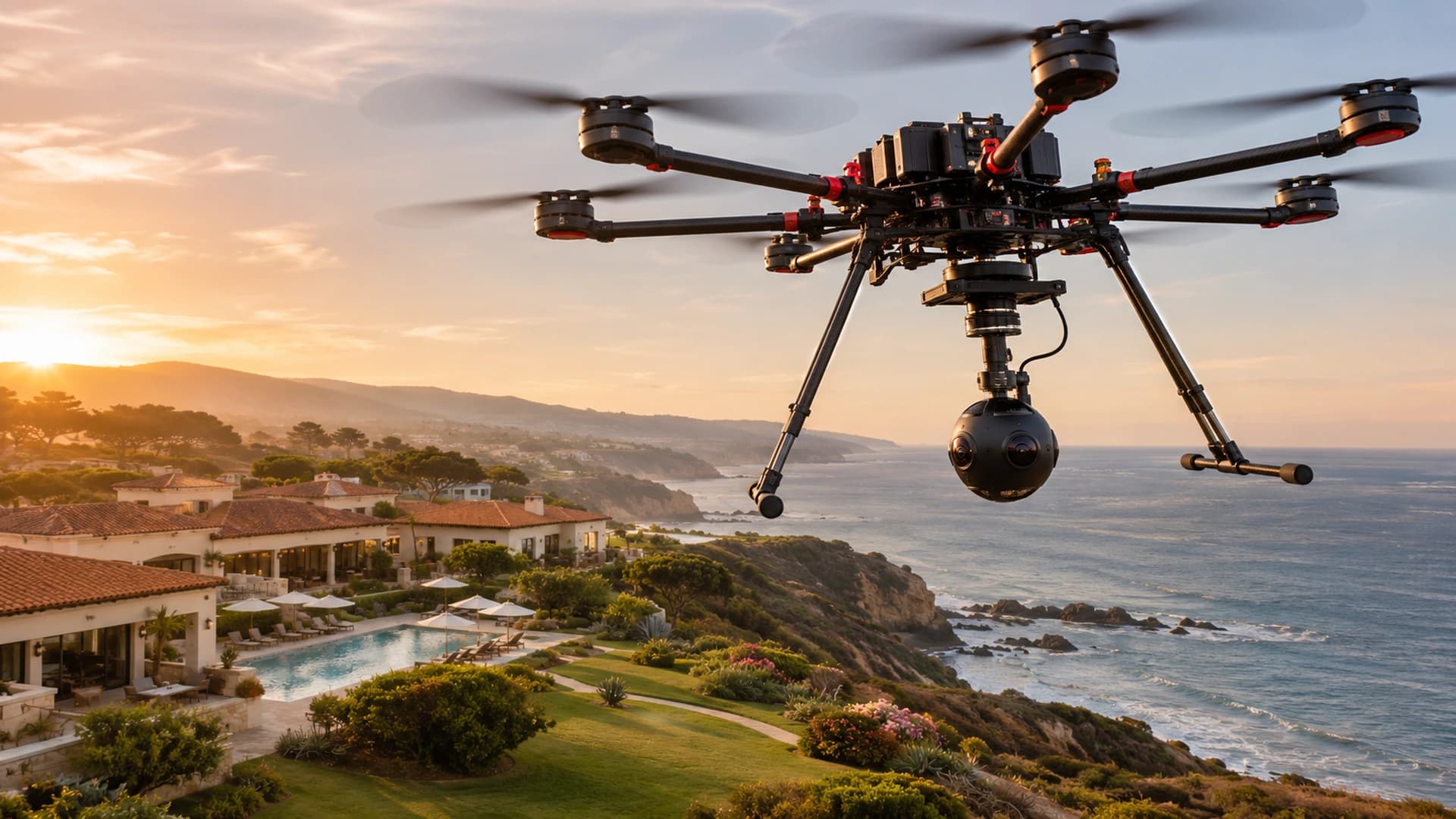
8K 360° Drones Are Changing Aerial Video Filming in South Africa
Aerial video used to offer audiences a view from above. A newer generation of 360° drones is making a different proposition: instead of looking only where a camera operator points the lens, viewers can look around a recorded location for themselves. For tourism destinations, property developments and live events, that changes the kind of story an aerial video can tell.
The change is no longer just a concept. Antigravity announced the commercial availability of its A1 8K 360° drone in December 2025. On 26 March 2026, DJI introduced the Avata 360, offering 8K spherical recording and the ability to select different viewing directions from one flight. These developments point towards a more accessible category of purpose-built equipment for immersive aerial filming, although neither product launch proves that every application needs 360° footage.
What changed in aerial 360° filming?
Traditional drone videos generally record a chosen direction. The pilot or camera operator frames a building, landscape or crowd and delivers a conventional rectangular video. That remains effective for a concise promotional film, especially when the filmmaker needs precise control over what the audience sees.
A 360° camera records the surrounding environment in multiple directions at once. Cameras with lenses facing above and below the aircraft can record overlapping views, which are stitched into a spherical image. The result can be presented as interactive video, allowing viewers to change their viewpoint, or edited into a standard flat sequence with virtual camera movements selected afterwards.
Both the Antigravity A1 and DJI Avata 360 demonstrate this approach with integrated 360° capture. DJI's announcement also describes 8K recording at up to 60 frames per second in its 360° mode. Independent coverage by DPReview confirms the emerging competition between dedicated 360° camera drones, while highlighting that manufacturers' sensor terminology deserves careful interpretation.
The important industry development is not simply the arrival of another drone model. It is the shift towards capturing a navigable environment during a single aerial movement, then deciding which perspective, or which combination of perspectives, best serves the audience.
The business case is about context, not novelty
A coastal resort can be difficult to explain through isolated photographs. Guests may want to understand how the buildings relate to the beach, outdoor areas and surrounding landscape. A 360° aerial sequence can allow them to explore those relationships from the air. It does not replace interior photography, booking information or a conventional property video, but it can communicate the wider setting in a distinct way.
For property developers and estate marketing teams, the potential value is similar. Aerial 360° video can show how buildings, access routes, neighbouring spaces and natural features sit together. The viewer can look towards the site, then turn towards the surroundings without the production needing a separate shot for every viewing direction. This makes geographic context a central part of the experience rather than a brief background detail.
Events offer a third application. A festival site, sporting venue or outdoor exhibition can be documented as a spatial environment rather than only a series of close-ups. Event organisers might use such footage to show venue scale, site layout and atmosphere to future partners or attendees. These are possible applications, not claims of measured increases in bookings, sales or attendance.
For education providers and organisations communicating about complex sites, the same principle may help audiences understand where facilities are located in relation to one another. Whether a 360° view is worthwhile depends on the importance of that spatial relationship to the message.
Why 8K matters, and why it is not the whole quality story
The term 8K attracts attention, but its meaning is different in spherical video from the experience of watching a conventional 8K television image. An 8K 360° file distributes its available pixels across a much wider field of view. A person looking in one direction sees only a portion of that sphere at a time. Consequently, an 8K capture does not mean that every individual viewport displays 8K detail.
Resolution remains useful because a large panoramic image needs enough information to support looking around and reframing. Yet the final result also depends on lens quality, exposure, stabilisation, stitching, camera movement and compression. Challenging light, fast-moving subjects and visible stitching seams can reduce the sense of presence even when the original file has a high pixel count.
The distinction matters for business purchasers. The right question is not only whether a supplier can record 8K, but whether the image stays clear and comfortable to explore on the devices the audience will actually use. A smooth, readable experience on a phone may be more valuable than an impressive specification that proves difficult to stream or navigate.
Capturing the scene is only half of the delivery
Spherical footage can serve different types of viewing. YouTube's current guidance confirms support for 180° and 360° video playback in compatible desktop browsers, the mobile app and YouTube VR on supported headsets. On desktop, viewers can drag or use controls to change direction; on mobile, they can interact with the view; a headset offers a more physically immersive presentation.
This breadth of delivery is an advantage, but it introduces editorial choices. Some audiences will actively explore a video; others will watch passively and need help understanding where to look. A guided version, supported by deliberate pacing and clear narration, may communicate better than an unguided recording in certain circumstances. A short conventional edit derived from the same spherical material can also suit channels where viewers expect a familiar fixed frame.
File size, platform processing, playback compatibility and connection quality must be considered alongside the initial capture. The strongest aerial experience is the one that reaches its intended audience in a useful form, not merely the one recorded at the highest setting.
South African commercial flights remain regulated
New camera hardware does not remove aviation responsibilities. The South African Civil Aviation Authority's unmanned-aircraft guidance distinguishes private flying from operations that have a commercial, corporate or other non-private purpose. Its Part 101 framework sets out requirements relating to operating approvals, aircraft registration, pilot licensing and the applicable operating certificate, depending on the operation.
A shoot involving a hotel, event venue or development may also raise questions about airspace, site access, people on the ground and privacy. The aircraft's advertised weight or the availability of consumer controls should not be taken as permission to conduct commercial filming wherever convenient. Requirements need to be checked against the proposed operation and the regulator's current rules.
For an organisation commissioning a production, this makes professional planning part of the creative outcome. The best aerial viewpoint may not be available from every location or at every time. Responsible operation shapes what can be filmed and how the finished experience is produced.
Where the industry is heading
The arrival of dedicated 8K 360° drones suggests that immersive aerial video is becoming easier to capture with purpose-built equipment. It does not mean conventional drone cinematography is obsolete. A tightly directed brand film, a precise inspection-style view and an explorable destination experience answer different questions. Often, the most effective communication combines fixed-frame storytelling with an optional interactive perspective.
For South African tourism, property and event organisations, the opportunity is to decide when the ability to look around genuinely adds information. A remarkable view can attract attention, but a clear spatial story can help people understand a place. That distinction is likely to matter more than a camera's headline resolution as the technology matures.
AltVR's 360° Video Filming service covers immersive aerial spherical footage, including high-resolution capture designed for exploration across compatible devices. Businesses considering a destination, property or event project can contact AltVR to discuss the setting, intended audience and type of viewing experience they want to create.