
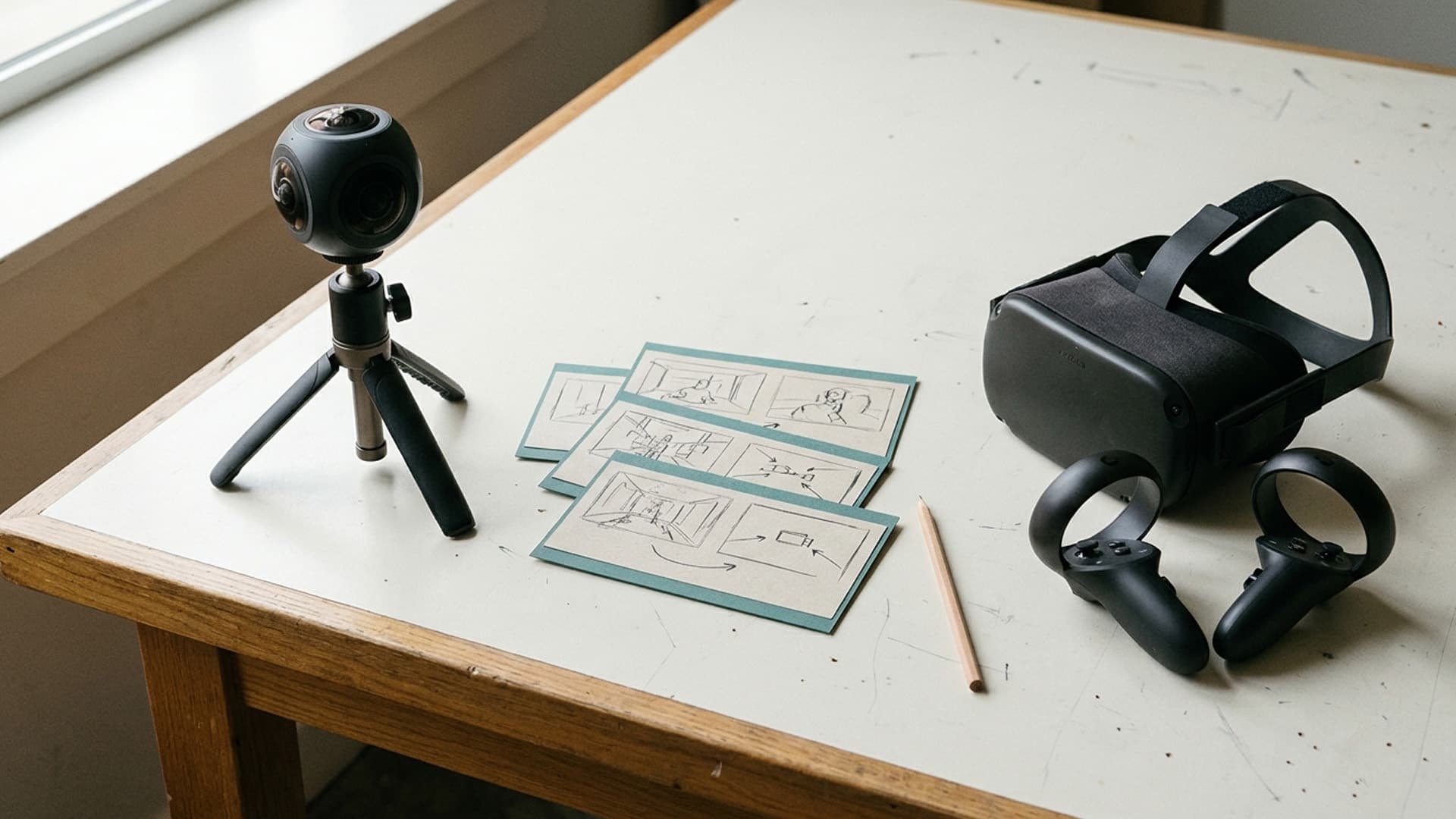
Choose 360 video when the main job is to show a recorded place, event or sequence from a controlled viewpoint. Choose interactive VR when the user needs to make meaningful choices, manipulate objects or move through a computer-generated environment. The decision starts with the required action, not with which format sounds more advanced.
Both approaches can be immersive, and both need careful production. They can also be combined. What matters is being precise about which parts are recorded, which are generated and what the audience can actually control. A headset alone does not tell you what kind of experience is inside it.
Finish the sentence: the viewer needs to...
Write one clear sentence about the audience's task. "The viewer needs to see the atmosphere of this venue" suggests a different production from "the viewer needs to practise selecting and fitting a component". The first may work well with filmed material. The second needs interaction designed around the object and its behaviour.
Some briefs contain both needs. A visitor may first need an overview of a real location and then a way to examine a proposed addition. Separate those tasks before choosing a single format for the whole project. A hybrid is an option, but its extra production and integration work should earn its place.
Ask what would be lost if the project used an ordinary video, photograph or webpage. The answer helps identify whether immersion supports the task or merely adds another stage between the audience and the information.
Looking around is not the same as walking anywhere
In a conventional 360 video, the audience can choose a viewing direction while the recorded camera position and sequence remain part of the footage. Looking behind you does not create a new viewpoint behind an object. This distinction matters when a client expects to explore every corner of a room freely.
Interactive VR can provide movement through a generated environment, but only within the implemented design. It does not automatically include every room, functioning object or real-world behaviour. Those features require assets, interaction logic and testing.
Explain these boundaries during briefing with a simple demonstration. Ask stakeholders to identify what they can control. Misunderstandings discovered at this stage are easier to address than a late expectation that filmed footage should behave like a fully modelled space.
Use recorded reality where it carries the message
A real location can contain details that are costly to recreate: everyday activity, complex textures, changing light and a particular atmosphere. Filming may be the appropriate approach when those details are the point of the experience and access to the location is possible.
The production brief still needs a plan. Establish where the camera can be placed, what should happen around it, which people or information must stay out of the shot and how sound will support the viewer's attention. A panoramic field of view makes uncontrolled surroundings particularly relevant.
For this route, AltVR's 360 video filming service provides a relevant discussion point. Prepare the location, intended audience and story before concentrating on equipment labels. A technically detailed recording can still fail to explain why the viewer is there.
Use interaction when an action changes the understanding
Interactive VR becomes useful when doing something is central to the lesson or demonstration. A user might compare layouts, inspect an assembly from several positions or try an agreed sequence with feedback. The interaction should help answer a question, not simply provide buttons to press.
Describe the result of each important action. If a person selects the wrong item, does the application explain the mistake, allow another attempt or stop the sequence? If a product is moved, where can it go? If the user walks away from the task, how do they return?
These are content decisions as much as software decisions. The person who understands the subject needs to work with the development team. An attractive model does not contain the operational knowledge needed to make every interaction meaningful.
Do not overlook simpler interactive formats
A 360 tour with navigation points and information panels can be interactive without being a fully simulated world. Likewise, a browser-based 3D model can let a visitor rotate an object without requiring a headset. These options may satisfy a brief that does not need a complete VR application.
AltVR's virtual tour service is relevant when the task centres on exploring a location through selected viewpoints. Describe whether users need spatial orientation, room-to-room browsing, information hotspots or free movement. These are different requirements.
Avoid using "interactive" as a single checkbox. List the actual controls and decisions the audience needs. That list makes proposals easier to compare and prevents a straightforward information journey from expanding into an unnecessary simulation.
Compare what happens when the content changes
Recorded footage may need a new shoot when a location, product or presenter changes. Smaller edits can sometimes reuse existing material, but the feasibility depends on what appears in the recording. Identify which parts are likely to become outdated before planning production.
A generated environment can also require substantial revision. A new product shape may mean asset work, materials, animation and testing. A change to a process may affect interaction logic rather than just a caption. Editable does not mean effortless or included at no additional cost.
Ask for the update process for each proposed format. Who supplies revised information? Who approves it? What needs rebuilding? Who retains the relevant source material? Compare the expected life of the content, not only the work required for its first release.
Choose distribution before committing to production
Decide how viewers will reach the experience. Possibilities include a website, an event headset or a managed application on specified equipment. Each route creates different packaging, support and testing requirements. An online link and an installation process are not interchangeable.
For example, YouTube's guidance for 180- and 360-degree uploads describes preparation and playback requirements for that platform. Treat those as platform-specific requirements, not proof that one exported file will work identically everywhere.
Test the intended delivery route with representative content before producing the entire project. Check whether the audience can find the controls, understand the opening view and receive the essential message on the devices you intend to support. Include an alternative for people who cannot use the immersive version.
Compare the work, not an invented price per minute
Duration alone is a poor basis for comparing these formats. A short interactive sequence may require several assets and complex behaviour. A longer filmed piece may involve difficult access, multiple locations or demanding post-production. Neither format has a universal cost advantage.
Ask proposals to explain their assumptions about preparation, assets, production, revisions, delivery and support. Check whether the same audience task is being addressed in each proposal. A visually cheaper option may omit the interaction or distribution route that the project actually needs.
Scope the first release around the most important outcome. Extra scenes, languages and interactions can be considered once the core experience has been evaluated. This makes the budget discussion more concrete without pretending that every project should follow the same production formula.
Make the choice with a small proof
When the format remains uncertain, build or film a representative fragment. Use it to answer one unresolved question: whether the viewpoint explains the space, whether an interaction clarifies the product, or whether the audience can use the delivery method.
Review that fragment against the original task sentence. If looking around provides the understanding needed, recorded content may be sufficient. If the audience must act and see a meaningful response, discuss the relevant interactive VR development scope.
The best format is the one that communicates the right thing under real conditions. A clear decision about viewer control, content updates and delivery is more valuable than choosing the most elaborate technology before anyone has defined the problem.